

Time Study Consultant
Professional Time Study Consulting and Work Measurement Services
Time Study Consultant
Professional Time Study Consulting and Work Measurement Services
Understand where employee time goes, how work is performed, and which changes can improve productivity. CapRock Global Solutions designs employee-friendly time studies around each organization’s operations and business questions, backed by 70 years of time study and methods engineering experience.
Our work measurement services provide objective data for staffing, labor standards, process improvement, capacity planning, and decisions about AI and automation. We measure the work, examine the conditions affecting it, and recommend practical next steps.
Request A Free Consult
"*" indicates required fields
Employee Friendly Time Studies
At CapRock, an employee-friendly time study means engaging employees as part of the process, listening to their experience, and making participation as seamless and easy as possible. Their input helps explain the measured results and shape feasible recommendations.
What Is a Time Study
A time study is a structured work-measurement method used to determine how long defined tasks and processes require under actual operating conditions. In the traditional time-study and methods-engineering approach, the objective is not simply to record elapsed time: it is to understand the work method, identify unnecessary effort or delay, and establish reliable task times for a defined method and set of operating conditions. The design may focus on a task, an end-to-end process, a role, a shift, or multiple locations.
CapRock uses the resulting time study data and evidence to help leaders make fact-based operational decisions about staffing, workflow, labor standards, productive capacity, process improvement, and how work should be performed. Rather than relying on assumptions about workload or employee utilization, organizations can use measured data to understand where time is being spent, how long work actually takes, what drives variation, and where capacity is being lost.
Time study data can be used to determine staffing requirements, establish or validate standard times and engineered labor standards, balance workloads, improve scheduling, evaluate employee and equipment utilization, identify bottlenecks, reduce waiting and delays, improve workflow and workplace layout, compare performance across locations or shifts, support capacity planning, and identify opportunities to reduce non-value-added work. The data can also help quantify the potential impact of process improvements and provide a baseline for measuring results after changes are implemented.
Time Study Data Answers Important Business and Operational Questions
- Identify where time is spent and where capacity is lost?
- Measure workload, utilization, delays, and process variation
- Develop staffing models or validate labor standards
- Prioritize operational improvements and appropriate automation
- What Can a Time Study Help You Determine?
- Where are employees spending their time?
- How many employees do we actually need?
- Which activities are value-added versus non-value-added?
- Where are employees waiting, traveling, searching, reworking, or performing unnecessary administrative work?
- Which processes should we automate?
- Where can AI eliminate or reduce manual work?
- What should the standard time for a task be?
- Are existing labor standards accurate?
- Where are the workflow bottlenecks?
- How can we increase productivity without simply adding staff?
- What staffing levels are required as volume changes?
What Time Study Can Measure
- Task, activity, process, and cycle times; work methods and sequences
- Employee utilization; productive, support, and non-value-added time
- Workload by role, shift, function, and location; staffing requirements.
- Waiting, delays, travel, searching, approvals, handoffs, and rework
- Equipment and system constraints; process variation and bottlenecks
- Standard times, labor standards, and potential AI or automation opportunities
- Any Task or Activity performed by an associate as well as machine or automation time.
70 Years of Time Study and Methods Engineering Experience
CapRock Global Solutions now carries forward the experience and technical heritage of the Industrial Time Study Institute (ITI), an organization with a documented history in time study and methods engineering dating back to 1956. Together, this represents 70 years of operating experience in time study work measurement, methods improvement, labor standards, and practical productivity analysis.
The Industrial Time Study Institute has long focused on the relationship between time study and methods engineering: measure the work, understand the method, identify a more efficient way to perform it, and establish a defensible standard for the improved method. CapRock applies that foundation to today’s operating questions, including staffing, capacity, process improvement, technology, AI, and automation.
This heritage also includes time study and methods training used by industrial engineers and operations professionals, as well as independent third-party time-study work used to validate installation and labor performance.
Identify Value Added and Non Value Added Work
A time study can separate value-added work, necessary support activities, and non-value-added time to provide a clear picture of how employee time is actually being used.
From a Lean perspective, identifying non-value-added activity is valuable because it helps reveal where processes create unnecessary effort, delays, or complexity. Examples may include waiting, searching for information, unnecessary travel or movement, duplicate data entry, excessive handoffs, rework, redundant approvals, or other activities that consume employee capacity without directly contributing to the desired outcome.
CapRock uses the study findings to identify opportunities to reduce waste, streamline workflows, eliminate unnecessary steps, improve efficiency, and free employee capacity for higher-value work. Depending on the findings, improvements may include process changes, better information access, reduced handoffs, improved workplace layout, standardized work, technology improvements, or appropriate AI and automation.
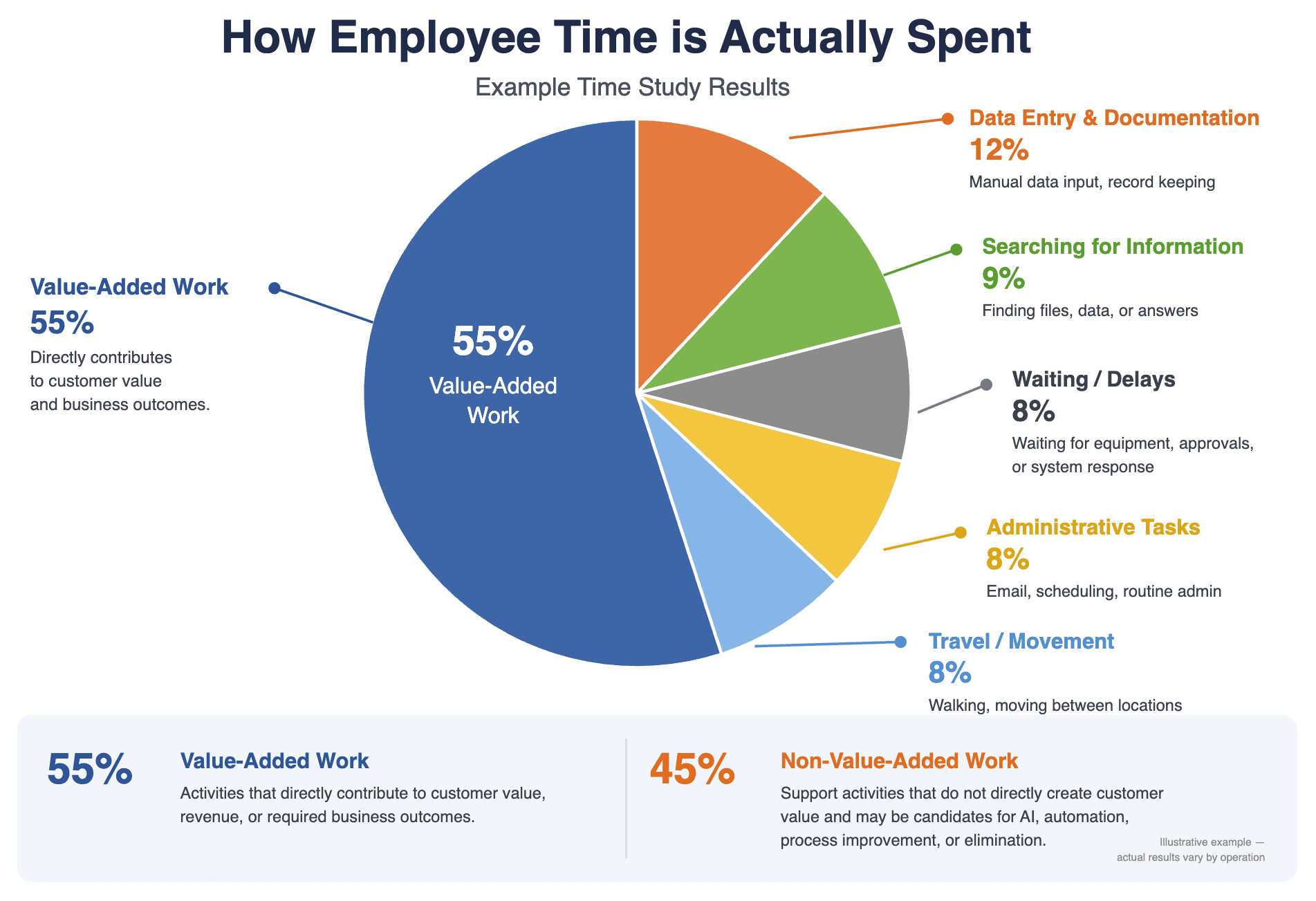
The result is a practical approach to Lean improvement: measure where time is going, identify the sources of waste and inefficiency, understand their root causes, and implement improvements that make the work easier and more productive.
| Activity | Time | Classification | Possible finding | Potential action |
|---|---|---|---|---|
| Core customer or operational work | 58% | Value added | Primary work | Protect capacity |
| Administrative work | 12% | Support; evaluate | Manual entry and reporting | Simplify or automate |
| Waiting and delays | 9% | Non value added | System or approval delay | Address root cause |
| Travel and movement | 7% | Evaluate | Excess movement | Redesign layout |
| Searching for information | 6% | Non value added | Poor information access | Improve access |
| Rework and duplicate work | 5% | Non value added | Errors or repeated entry | Fix process |
| Other activities | 3% | Evaluate | Requires more detail | Investigate |
Find the Right Opportunities for AI and Automation
Before investing in technology, establish what employees do, how much time it takes, and why the work exists. The study helps distinguish work to eliminate or simplify from work that is suitable for automation or AI assistance. Promising candidates still require evaluation of quality, data, cost, risk, and operational fit.
Measure the work → Identify avoidable time → Find root causes → Evaluate technology options → Prioritize the business case.
| Study finding | Question | Possible response |
|---|---|---|
| Unnecessary task | Is the activity required? | Eliminate |
| Inefficient process | Can the method be simplified? | Improve |
| Repetitive manual task | Can technology perform it reliably? | Automate |
| Information intensive task | Could AI assist an employee? | Test AI assistance |
| High value employee work | How can capacity be protected? | Optimize or expand |
Examples for evaluation include data entry, document processing, information retrieval, scheduling, workflow routing, reporting, and routine communications. Final choices depend on the measured work and the organization’s requirements.
Turn Findings into Measurable Results
CapRock evaluates opportunities by potential capacity, labor impact, implementation effort, investment, speed to benefit, and operational risk. A practical action plan may begin with changes that are easy to implement and then address technology or process changes that require more planning.
| Opportunity | Capacity impact | Effort | Speed | Priority |
|---|---|---|---|---|
| Eliminate duplicate reporting | High | Low | Immediate | Quick win |
| Reduce approval delays | Medium | Low | Immediate | Quick win |
| Improve information access | Medium | Medium | Near term | Near term |
| AI assisted administration | High | Medium | Near term | Evaluate |
| Workflow automation | High | Medium to high | Medium term | Strategic |
| Major process redesign | High | High | Longer term | Strategic |
Create More Capacity for Priority Work
Reducing avoidable administrative effort, waiting, travel, searching, and rework can increase the time available for core responsibilities. The graphic shows an example scenario, not a forecast or guaranteed outcome.
Staffing and Workforce Planning
Workload and task-time evidence can support staffing models by role, shift, location, and function. CapRock can combine activity frequency, measured time, productive availability, service requirements, and peaks in demand to estimate capacity needs. Scenario analysis can show how workload growth or process changes may affect those needs.
Engineered Labor Standards and Standard Times
For defined tasks, work measurement can support the development or validation of standard times. Building on traditional time study and methods engineering, CapRock examines the work elements, method and sequence, observed time, activity frequency, variation, operating conditions, and applicable allowances. Where appropriate, the study can also evaluate whether the current method should be improved before a standard is finalized. The resulting standards can inform scheduling, capacity planning, budgeting, labor forecasts, incentive or performance systems where applicable, and productivity measurement.
Methods Selected for the Work
- Direct observation and stopwatch time studies for defined work elements, cycles, and standard-time development
- Work sampling to estimate the distribution of varied activities.
- Activity and utilization studies across roles or shifts
- Methods engineering and process studies to examine work sequence, handoffs, motion, bottlenecks, and end-to-end time.
- Video analysis where appropriate and approved.
- Standardized-work and method analysis to document the preferred work sequence and reduce avoidable variation.
- Predetermined motion-time systems, such as MOST, MTM, or MODAPTS, when appropriate to the project scope
The approach, precision, observation coverage, and sample size are determined during project scoping.
Industries and Operations
Time studies can be designed for any industry where people work in their environment for example: retail, QSR, manufacturing, warehousing and distribution, telecom, Data Centers, healthcare, pharma, hospitals, labs, doctor practices, restaurants, financial/banking/admin field service, customer service, aerospace , automotive, administrative operations, maintenance, logistics, energy / utilities, and multi-location organizations. Each study uses activity definitions and coverage suited to the operation and industry.
Typical Project Schedule
A typical engagement may take approximately two to six weeks. The schedule depends on the time study scope, scale, locations, functions, shifts, access, observation coverage, and the analyses requested.
1. Project preparation and kickoff
Confirm objectives and scope; define activities; select roles, sites, shifts, and study periods; agree on employee communication and collection plan.
2. Conduct the study
Collect observations under the selected method and monitor coverage throughout data collection.
3. Provide progress updates
Share progress and resolve coverage or data questions while collection is underway.
4. Analyze the data
Examine task times, workload, utilization, delays, variation, staffing, and improvement opportunities.
5. Review the draft
Discuss preliminary findings with the client team and validate operational context.
6. Present recommendations
Deliver final findings, priorities, and next steps; define implementation support if requested.
What Clients Receive
Deliverables are set in the project scope. They may include an observation database, activity and utilization analysis, task and process times, workload and staffing analysis, labor standards, comparison across sites or shifts, prioritized opportunities, and a management presentation.
The value of a time study is therefore not simply knowing how long work takes. It is turning objective work-measurement data into actionable information that helps an organization determine how much capacity it has, how much staffing it needs, where work can be improved, and where people, processes, technology, AI, and automation can be used more effectively.
| Metric | Location A | Location B | Location C | What to examine |
|---|---|---|---|---|
| Value-added time | 61% | 54% | 67% | Why locations differ |
| Administrative time | 11% | 16% | 9% | Simplification |
| Delay and waiting | 8% | 13% | 6% | Root causes |
| Travel and movement | 9% | 7% | 8% | Workflow and layout |
| Rework | 4% | 5% | 3% | Process issues |
| Other activities | 7% | 5% | 7% | Further analysis |
Frequently Asked Questions
What does a time study consultant do?
A consultant measures how work is performed and how time is allocated, then analyzes the implications for staffing, standards, capacity, and improvement.
How does a time study differ from a time and motion study?
A time study measures duration and distribution of work. A time and motion study may also examine physical motions, layout, sequence, and work methods.
How long does a study take?
Many engagements can be completed in about two to six weeks, depending on scope and observation requirements.
Can it determine staffing requirements?
Measured activity times can be combined with workload, productive availability, and coverage requirements to inform a staffing model.
Can it identify AI and automation opportunities?
Yes. The study can surface repetitive or information intensive tasks for further evaluation and clarify which problems should be addressed through process changes.
What is work sampling?
Work sampling uses observations at selected times to estimate the share of time spent on defined activities.
What are engineered labor standards?
They are expected times for defined work under specified methods and operating conditions, developed using structured work measurement.
Are employees involved?
Yes. Employee communication and operational input help explain the work and improve the usefulness of the findings.
Can multiple locations and shifts be compared?
Yes, when the sampling and scope are designed to support those comparisons.
How much time study experience does CapRock have?
CapRock brings 70 years of operating experience in time study, work measurement, and methods engineering through the Industrial Time Study Institute heritage, combined with CapRock’s current consulting capabilities in staffing, productivity improvement, process analysis, AI, and automation.
Why Work With a Time Study Consultant
At CapRock, our Time Study consultant services provide dedicated time study observations and analysis, a consistent measurement method, and an outside perspective. CapRock combines that independence with 70 years of time study and methods engineering experience through the Industrial Time Study Institute heritage. That depth can help an organization compare locations, test staffing assumptions, validate standards, evaluate methods, and build a shared fact base for operational decisions.
Ready to find out more?
Contact us today to talk with a CapRock Time Study Consultant!